Smart Factory explained simply - how the digital factory works
Smart Factory explained simply: What is a Smart Factory?
A smart factory is No single system and no specific software.
It describes an overarching production concept in which machines, processes, automation and digital systems are networked in such a way that production processes become transparent, flexible and controllable.
The decisive factor here is not the technology itself, but the Interaction of all levels. A smart factory is created where data is not created in isolation, but is used consistently - from the machine to the process to the production organization.
In short:
A smart factory is a Digitally organized production, in which decisions can be made on the basis of current data.

What are the goals of a smart factory?
Typical objectives are
- Transparency on current processes, statuses and key figures
- Flexibility for product variants, batch sizes and short-term changes
- Stability in production despite increasing complexity
- Responsiveness in the event of disruptions, bottlenecks or deviations from the plan
- Efficiency in the use of resources, energy and materials
The smart factory thus creates the basis for not only executing production, but also actively manage and further develop.
Which technologies form the basis of a smart factory?
A smart factory is not based on a single technology, but on several interlocking components. Their integration is crucial.
The basic technologies include:
- Networked machines and systems, that provide relevant operating and process data
- Sensors, to record states in real time
- Digital production systems, such as MES (Manufacturing Execution System) or MOM (Manufacturing Operations Management), which control production orders, coordinate resources and create transparency across all processes
- Automation and robotics, to execute processes in a stable and reproducible manner
- Intralogistics solutions such as FTS or AMR
- IT/OT integration, so that data can be used across systems
Only by combining these elements can an end-to-end digital factory be created.
How do the levels interact in the Smart Factory?
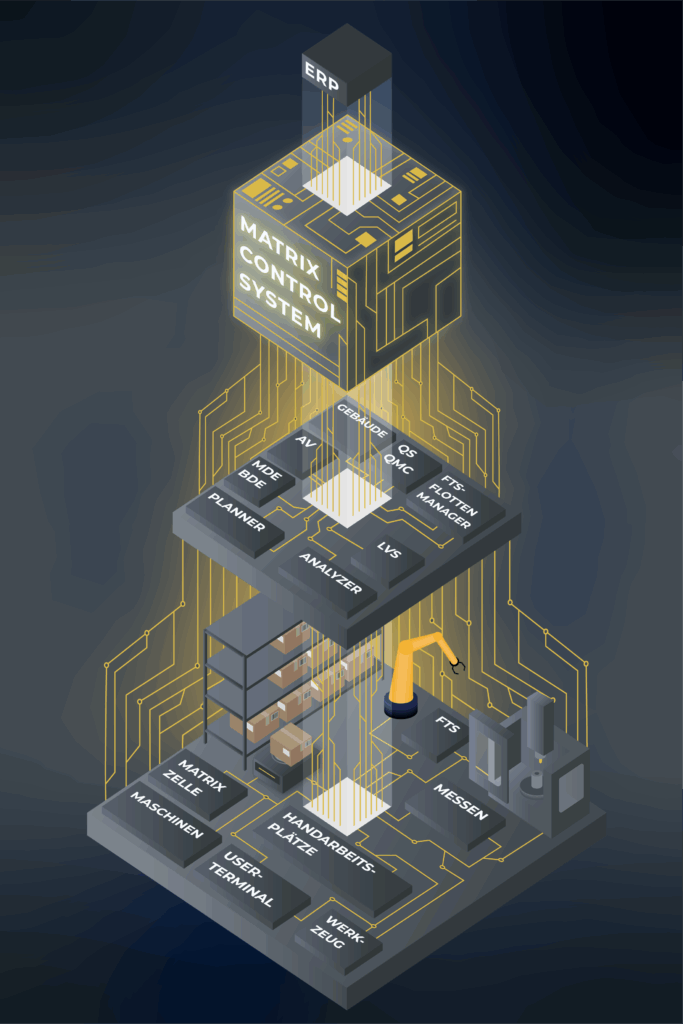
A central feature of the Smart Factory is the Continuous flow of information across all levels.
Instead of isolated systems, networked processes are emerging:
- Machines provide status and process data
- Processes are coordinated across departments
- Production decisions are based on up-to-date information
- Planning, execution and analysis interlock
It's not about making every decision centrally, but about making every decision centrally, Transparency and decision-making ability at all levels. This is precisely where the smart factory differs from classic automation.
Smart Factory is created through combination - not through a single system
A smart factory is No next development step according to a specific system, but the result of an interplay.
In combination with advanced automation the organizational and digital basis is used to create production environments that are highly integrated and increasingly able to operate independently.
The better systems, processes and automation interact, the closer we get to the goal of largely autonomous production.
A practical approach: how a smart factory is created step by step
In reality, a smart factory is rarely created all at once. Successful companies take a step-by-step approach.
- Create transparency
Relevant production data is recorded and made available in a structured manner. - Targeted use of automation
Recurring or critical processes are automated. - Deepening integration
Logistics, quality, energy flows and planning are integrated. - Enable optimization
Key figures serve as the basis for continuous improvement.
This approach avoids major upheavals and enables sustainable development.
Smart Factory is not a project, but a development process
A common mistake is to view the Smart Factory as a one-off project. In reality, it is a permanent development process.
General conditions are constantly changing:
- new products
- new technologies
- Changed market requirements
- Organizational adjustments
A smart factory must therefore can grow with you. Modularity, scalability and openness are key requirements.
How MCS supports smart factory structures
For smart factory concepts to work in practice, a digital foundation is needed that links data, processes and decisions across all areas.
Our MCS - Matrix Control System - is one such platform. It enables:
- Consistent recording and consolidation of production, system and process data
- Integration of existing machines, automation solutions and IT systems
- Central planning, resource and capacity analysis
- Integration of energy and intralogistics data
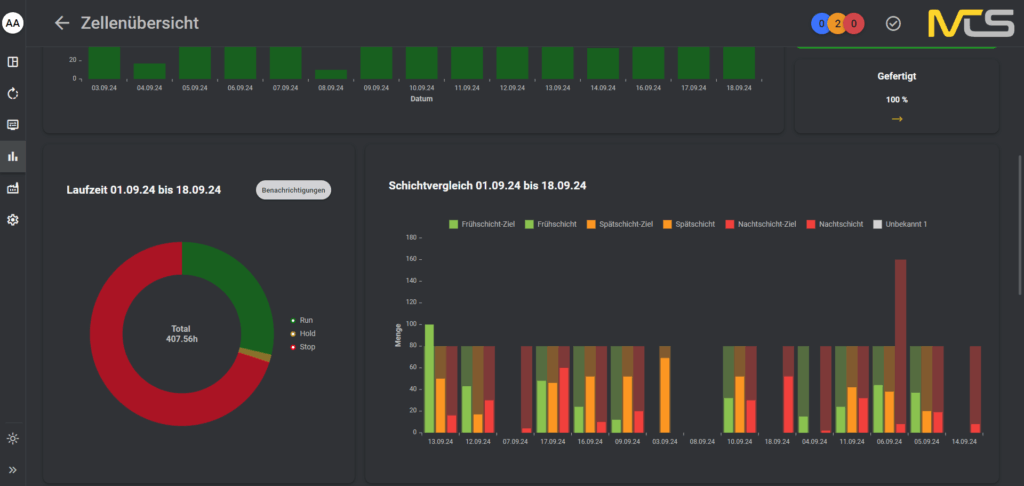
- Uniform KPI calculation and role-based visualization
- Real-time transparency of statuses, deviations and correlations
A key advantage of MCS is that companies can do not have to start with a complete expansion stage. The system can be introduced with the currently required functions and Gradually supplemented with further modules and add-ons become. MCS is growing in the own pace with the organization, processes and maturity level of production.
MCS thus forms a flexible, sustainable and future-proof basis for smart factory structures - from networked manufacturing to highly integrated, data-driven production environments.
Outlook: From the smart factory to the dark factory
Smart factory structures are the prerequisite for fully digitalized production.
The Dark Factory represents the next stage of development: a production environment in which networked systems, automation and intelligent control are integrated to such an extent that processes can run almost without human intervention.
In the next article, we will take a closer look at what exactly is behind this, how realistic this scenario already is today and which technical and organizational requirements need to be met.
→ Dark Factory - What unmanned production will look like in the future